

How to Choose a CNC Machining Supplier Before Sending an RFQ
Do not qualify a CNC machining supplier by equipment lists or the lowest visible price alone. Before sending an RFQ, verify whether the supplier can interpret the drawing, ask useful DFM questions, connect inspection evidence to critical features, control revisions, and state quote assumptions and exclusions clearly.
This is a buyer qualification framework, not a supplier ranking or a substitute for project-specific engineering review. The goal is to make two supplier responses easier to compare before a drawing, material, finish, inspection, or delivery assumption becomes a costly surprise.
1. What a qualified CNC machining supplier should prove before quoting
A supplier’s capability statement is a starting point, not proof that the supplier is a fit for your part. The relevant question is whether the supplier can explain how it will review and control the requirements in your actual RFQ package.
Ask for evidence in five areas:
- Process fit: Can the supplier identify the relevant milling, turning, finishing, inspection, and packaging requirements for this part?
- Engineering response: Does the supplier ask about unclear datums, critical-to-quality features, thin walls, deep features, finish allowances, or model-to-drawing conflicts?
- Quality evidence: Can the supplier explain which inspection records may apply and how the reported features will be measured?
- Document control: Will the quotation identify the drawing revision, assumptions, exclusions, and any open questions?
- Commercial scope: Does the response separate material, machining, finishing, inspection, documents, packaging, freight, NRE or tooling, and delivery assumptions?
A supplier may be technically capable and still be the wrong fit for a specific part. Qualification should therefore be tied to the drawing, quantity, material, finish, inspection scope, and delivery context—not only to a general list of machines or materials.
2. Start with a controlled RFQ package
A fair supplier comparison starts with the same controlled information. Send the same part number, revision, 3D model, 2D drawing, material requirement, quantity, finish, inspection scope, and delivery assumptions to each candidate supplier.
If your files are not ready, use the CNC machining drawing package checklist before requesting quotes. That supporting guide covers the buyer-side file package. This article takes the next step: how to evaluate the supplier’s response to that package.
At minimum, record:
- Part number and current drawing revision
- Matching 3D model and controlled 2D drawing
- Material grade and condition
- General and critical tolerances
- Datum and CTQ requirements
- Surface finish and post-processing
- Inspection records and acceptance criteria
- Prototype, sample, production, and forecast quantities
- Packaging, destination, and requested delivery information
Do not send different revisions or different acceptance requirements to different suppliers and then compare the prices as if the scope were identical. Quote comparability depends on scope control.
3. Use an evidence matrix, not a capability-list comparison
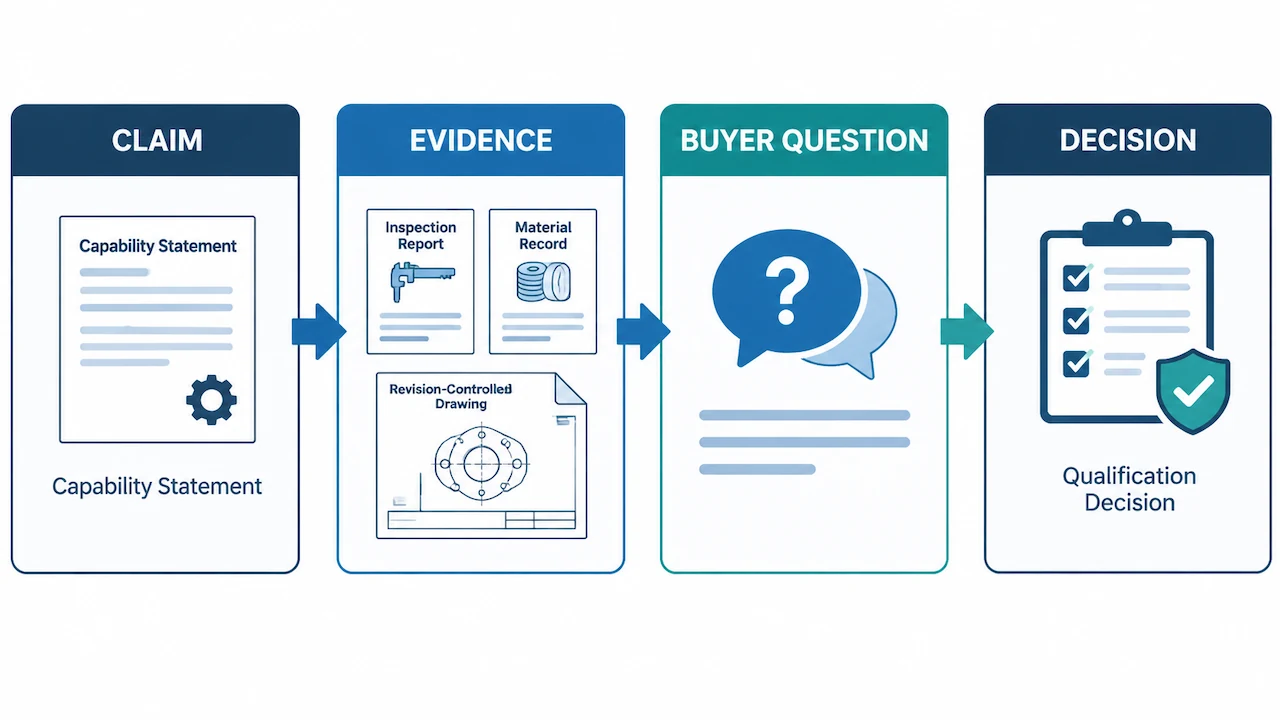
A capability list tells you what a supplier says it can do. An evidence matrix records what you asked for, what was supplied, and what still needs clarification.
| Supplier claim | Evidence to request | Buyer question | Decision status |
|---|---|---|---|
| Can manufacture the part | Process-fit response tied to the drawing and geometry | Did the supplier identify access, setup, or feature risks? | Confirm / clarify |
| Understands critical features | Marked CTQ or datum questions and proposed inspection approach | Are the functional features understood? | Confirm / clarify |
| Controls material | Material grade/condition confirmation and applicable material record plan | Are substitution rules and documentation clear? | Confirm / clarify |
| Controls revisions | Quotation references part number and current revision | Does the quote identify the exact files used? | Confirm / clarify |
| Supports inspection | Sample report format or documented inspection scope | Does the evidence cover the required CTQs? | Confirm / clarify |
| Manages finishing | Finish, masking, and pre/post-finish assumptions | Are fit and dimensional effects addressed? | Confirm / clarify |
| Provides a complete quote | Written assumptions, exclusions, and commercial scope | Can two responses be compared line by line? | Confirm / clarify |
A supplier that responds with useful questions is not necessarily creating friction. For a complex part, targeted questions can show that the supplier is reviewing the requirements rather than copying a price from an incomplete file set.
4. Check the engineering response before comparing price
Read the supplier’s questions before opening the price column. A low quote based on an unspoken assumption is not directly comparable with a higher quote that includes inspection, finishing, packaging, or clarification work.
Look for a written response to issues such as:
Drawing and model conflicts
The supplier should identify a conflict between the 3D model and controlled 2D drawing instead of silently selecting one. The quotation should state which revision and files were reviewed.
Datums, CTQs, and tolerance risk
The response should identify critical interfaces, datum relationships, position requirements, fits, or concentrated tolerances that need manufacturing or inspection review. It should not simply repeat the drawing title and call the package complete.
DFM questions
Useful DFM feedback may address tool access, workholding, deep features, thin walls, internal radii, burr control, finish allowances, or the measurement method for a critical feature. The purpose is not to redesign the part without authorization. The purpose is to expose questions early enough for the design owner to decide.
Finish and post-processing assumptions
The supplier should distinguish as-machined requirements from anodizing, plating, passivation, heat treatment, polishing, blasting, or other post-processing. Ask whether critical dimensions or fits are checked before or after the finish when that affects acceptance.
A response that contains no questions is not automatically wrong. It should still make its assumptions visible, especially when the drawing includes complex geometry, tight functional requirements, or a non-standard inspection package.
5. Verify inspection evidence
Inspection evidence should be connected to the features that matter. A generic statement such as “quality guaranteed” does not explain what was measured, by which method, against which revision, or with what acceptance criteria.
Ask the supplier to clarify:
- Which CTQs and datums will be inspected
- Whether the inspection is first-piece, first-article, sample-based, or production-based
- Which measurement method applies to each critical feature
- What report format will be supplied
- Whether a CMM, dimensional report, material record, or certificate is relevant to the project
- How deviations will be documented and dispositioned
- Whether the report references the same drawing revision as the quote
For report interpretation, use JXD’s guide on how to read a CMM inspection report. For the broader public overview, see quality assurance and inspection capabilities. These pages provide context; the exact inspection scope and document availability must still be confirmed for the specific project.
Do not treat a certificate logo or an undated sample document as proof that a supplier can satisfy your project’s acceptance requirements. Verify the document scope, current applicability, and relationship to the quoted part.
6. Verify material, finish, and document control
Material and finish requirements should appear in the supplier’s written response, not only in an attachment name. Check whether the quote identifies:
- Material grade and condition
- Approved substitution process
- Material traceability or material record requirements
- Surface finish, coating, plating, or treatment scope
- Masking and keep-out areas
- Pre-finish and post-finish dimensional assumptions
- Required CoC, MTR, RoHS/REACH, or finish documentation where applicable
- Packaging needed to protect the finished surface
JXD’s quality control and traceability guide provides a related reference on traceability and material-control questions. Do not expand a public page’s general information into a project-specific certificate, tolerance, or inspection promise without current engineering confirmation.
Revision control matters after the first response too. Record the part number, revision, quote version, clarification log, and any approved change. If the supplier changes an assumption after the design revision changes, keep the old response identifiable rather than overwriting the history.
7. Compare quote scope line by line
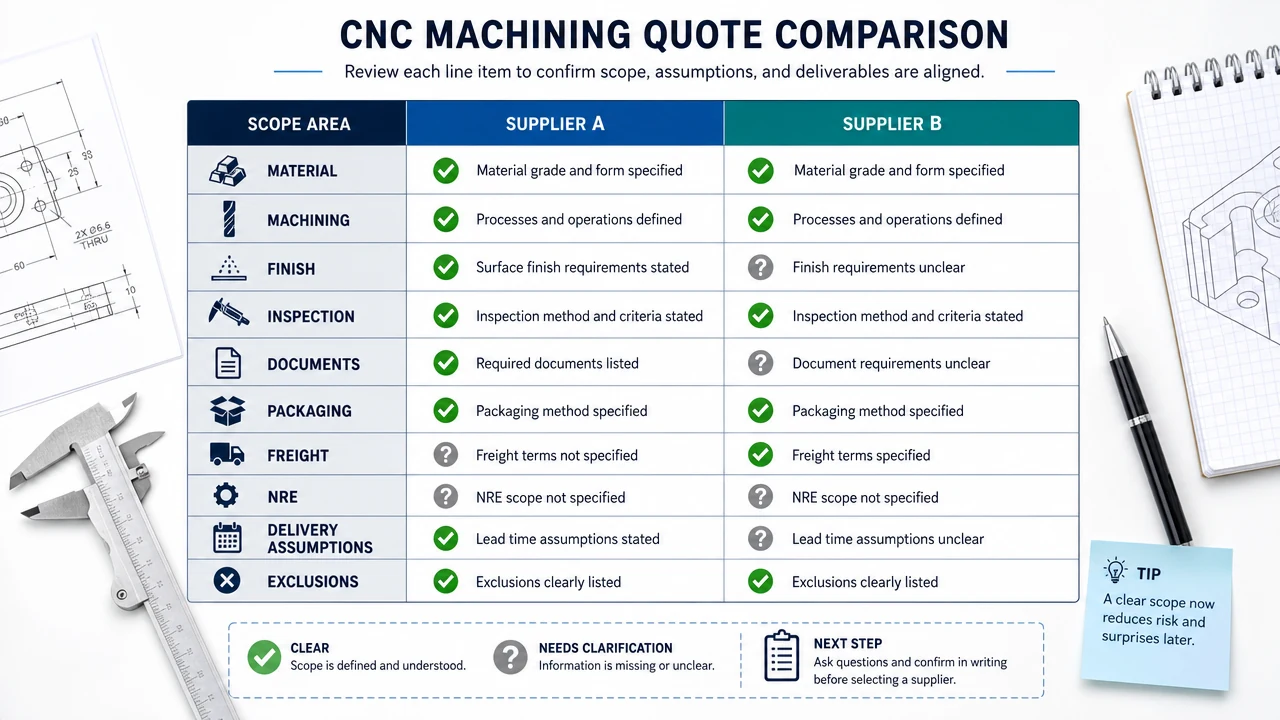
Price comparison is useful only after scope comparison. Put each supplier response into the same review table and mark whether each line is included, excluded, provisional, or unclear.
| Quote line | Supplier A | Supplier B | Buyer review question |
|---|---|---|---|
| Material | Included / excluded / unclear | Included / excluded / unclear | Same grade and condition? |
| Machining | Included / excluded / unclear | Included / excluded / unclear | Same geometry and revision? |
| Finish | Included / excluded / unclear | Included / excluded / unclear | Same finish, masking, and scope? |
| Inspection | Included / excluded / unclear | Included / excluded / unclear | Same CTQs, method, and report? |
| Documents | Included / excluded / unclear | Included / excluded / unclear | Same MTR, CoC, or other records? |
| Packaging | Included / excluded / unclear | Included / excluded / unclear | Same protection and labeling? |
| Freight | Included / excluded / unclear | Included / excluded / unclear | Same destination and shipping assumption? |
| NRE or tooling | Included / excluded / unclear | Included / excluded / unclear | Is a one-time charge separated? |
| Delivery assumptions | Stated / provisional / unclear | Stated / provisional / unclear | Are quantity and requested date the same? |
| Exclusions | Listed / missing | Listed / missing | What is outside the price? |
Do not fill an unclear cell with an assumption. Send the same clarification question to each supplier and record the answer against the same revision. A quote that is slightly higher may be more comparable if it explicitly includes requirements that another quote leaves open.
8. Identify supplier red flags before the first order
The following signals should trigger clarification or a controlled re-review. None is an automatic verdict by itself.
- The supplier sends a price without identifying the drawing revision or files reviewed.
- The response repeats “no problem” but does not address a critical datum, CTQ, finish, or inspection requirement.
- Inspection language is vague and no feature scope or report format is defined.
- Material substitution is implied but not disclosed or approved.
- The supplier cannot explain how a revision change will affect the quote.
- Certificates are shown without current scope, applicability, or project linkage.
- Packaging and freight assumptions are missing even though the part has a cosmetic finish or sensitive interface.
- A fixed delivery promise is given without quantity, material, finish, documentation, or schedule assumptions.
- The supplier resists documenting exclusions or open questions.
- The buyer is asked to approve production while drawing or model conflicts remain unresolved.
These signals do not prove that a supplier is unsuitable. They tell you where to request evidence, clarification, or a second review before placing an order.
9. A buyer-ready CNC supplier qualification checklist
Use this checklist for each candidate supplier. Keep the supplier response, evidence, open questions, and owner together.
Engineering fit
- Supplier identified the part number and drawing revision reviewed.
- 3D model and controlled 2D drawing were checked for agreement.
- Process route and access risks were discussed where relevant.
- DFM questions were specific to the actual geometry.
- CTQs, datums, fits, and critical tolerances were acknowledged.
- Finish and post-processing assumptions were stated.
Quality evidence
- Inspection scope is tied to CTQs and acceptance criteria.
- Measurement method or report format is defined where needed.
- Material records or certificates are listed only when applicable.
- The supplier can explain how deviations will be reported.
- Evidence references the same part and revision as the quote.
Quote comparability
- Material and condition are included or clearly excluded.
- Machining scope is defined.
- Finish and masking are defined.
- Inspection and documents are defined.
- Packaging, freight, and destination assumptions are defined.
- NRE, tooling, or one-time charges are separated.
- Delivery assumptions and requested quantity are stated.
- Exclusions and provisional items are listed.
Control and communication
- Clarification questions are recorded.
- Revision changes have a traceable response.
- The responsible contact for engineering questions is identified.
- Approval ownership is clear before production release.
- No unresolved drawing/model conflict is hidden in the quote.
10. When direct China sourcing is or is not a fit
Supplier qualification should include logistics and communication context, but it should not assume that one sourcing route fits every project. Consider direct China sourcing when the project can support controlled document exchange, clear quality requirements, realistic logistics planning, and the time needed for engineering clarification and approval.
It may be a poor fit when the project requires local service, very short physical response time, unresolved design changes, unclear acceptance criteria, or a commercial process that cannot handle freight, packaging, customs, and responsibility boundaries.
For the broader sourcing and landed-cost questions, see the China CNC machining outsourcing guide. This article does not repeat that guide’s full cost or Incoterms discussion; it focuses on evidence used to qualify the supplier before the commercial comparison.
11. Choose the next technical path
Once the supplier has reviewed the package, the next step depends on the part. For milling requirements, review CNC milling services. For turned components, review CNC turning services.
These service pages are context, not automatic process approval. The appropriate route still depends on geometry, material, dimensions, tolerances, finish, quantity, and inspection requirements.
12. Submit an evidence-ready RFQ
Need to qualify a supplier for a real part? Submit your CNC machining RFQ with the controlled STEP file and 2D drawing, material, quantity, critical tolerances, finish, inspection requirements, packaging requirements, and delivery information.
If a requirement is provisional, label it as provisional. If the model and drawing conflict, identify the conflict. If you need DFM feedback, list the specific feature or decision that needs review. This creates a clearer engineering starting point without turning a click, chat, or quote request into an unverified lead claim.
FAQ
What should I ask a CNC machining supplier before sending files?
Ask how the supplier will control the part revision, review drawing and model consistency, identify CTQs and DFM questions, handle material and finish requirements, define inspection evidence, and state quote assumptions and exclusions. Use the same controlled package and questions for each candidate supplier.
How do I compare two CNC machining quotes?
Compare the scope before comparing the price. Put material, machining, finish, inspection, documents, packaging, freight, NRE or tooling, delivery assumptions, and exclusions into the same table. Mark every unclear item and send the same clarification question to both suppliers.
What inspection evidence should I request?
Request evidence that matches the project’s acceptance requirements. Depending on the part, this may include a dimensional report, FAI, CMM report, material record, CoC, RoHS/REACH document, or finish certificate. Define the features, method, format, sampling, and revision reference rather than requesting a vague “full inspection report.”
Is an ISO certificate enough to qualify a CNC supplier?
No single certificate replaces project-specific qualification. Verify the certificate’s current scope and applicability, then review the supplier’s engineering response, revision control, CTQ inspection plan, material records, quote assumptions, and documented exclusions for the actual part.
Should I send a STEP file without a 2D drawing?
A STEP file communicates geometry but may not define tolerances, datums, material condition, finish, inspection scope, or revision authority. Send a controlled 2D drawing when those requirements affect manufacturing or acceptance, and state which document controls if the files disagree.
When should I request a DFM review?
Request DFM feedback when the geometry, material, tolerance, finish, inspection scope, or revision status may affect manufacturability or acceptance. Ask targeted questions about tool access, workholding, deep features, thin walls, critical datums, finish allowances, and measurement methods.
What is a supplier red flag before the first order?
A price with no identified revision, no written assumptions, vague inspection scope, undisclosed material substitution, or resistance to documenting exclusions should trigger clarification. These signals require a controlled review; they are not, by themselves, proof that the supplier cannot perform.
CTA
Need to qualify a supplier for a real part? Submit your CNC machining RFQ with the controlled STEP file and 2D drawing, material, quantity, critical tolerances, finish, inspection requirements, packaging requirements, and delivery information for engineering review.
 English
 German
 Italian
 Russian
 Spanish
 Turkish
 French
 Portuguese