
For medical device engineers and aerospace procurement managers, choosing between Polyetheretherketone (PEEK) and Polyetherimide (Ultem/PEI) is rarely about general “performance.” It comes down to a specific trade-off between thermal-mechanical stability e total cost of ownership (TCO).
At JXD Machining, where we handle precision CNC plastic parts with tolerances down to ±0.005 mm, we see these two polymers dominate 80% of our high-performance plastic RFQs. While PEEK is the “gold standard,” Ultem often provides a 30-40% cost reduction without sacrificing functional integrity in specific environments.
Here is the engineering-grade breakdown of PEEK vs. Ultem (PEI) from the perspective of the machine shop floor.
1. Mechanical & Thermal Comparison: The Fact Sheet
Before looking at tool paths, let’s review the physical limits of these materials.
| Propriedade | PEEK (Unfilled) | Ultem 1000 (PEI) | Engineering Impact |
|---|---|---|---|
| Resistência à Tração | 97 – 100 MPa | 105 – 110 MPa | Ultem is slightly stiffer but more brittle. |
| Glass Transition (Tg) | 143 °C | 217 °C | Ultem maintains stiffness at higher temps before softening. |
| Service Temp (Long Term) | 240 °C | 170 °C | PEEK survives continuous heat that melts Ultem. |
| Resistência Química | Exceptional (All common acids/bases) | High (Weakened by some solvents) | PEEK is mandatory for harsh autoclave/chemical sterilization. |
| Standard Grade | Victrex PEEK 450G | Sabic Ultem 1000 | PEEK is often specified by brand/grade (e.g., 450G). |
2. Machinability Challenges: The JXD Factory Perspective
Machining these polymers is not like cutting Aluminum 6061. The thermal expansion coefficients are significantly higher, and “internal stress” is the enemy of precision.
PEEK: The Stress Management Challenge
PEEK 450G is semi-crystalline. During the machining of thin-walled connectors or long micro-pins (a JXD specialty), the material tends to “move” as internal stresses are released.
JXD Factory Tip: For tolerances tighter than ±0.01 mm, we implement a dual-annealing process. We rough machine to +0.5 mm, re-anneal at 150 °C for 2-4 hours, and then perform the finish pass. This prevents the part from warping post-inspection.
Ultem (PEI): The Brittle Margin
Ultem is amorphous. It is prone to stress cracking (crazing) if the cutting temperature is not managed. Unlike PEEK, which melts if overheated, Ultem will micro-crack or “chip” at the edges, especially during high-speed milling.
JXD Factory Tip: We avoid oil-based coolants with Ultem if the part requires post-machining bonding, as some oils trigger environmental stress cracking. We use water-soluble coolants and PCD (Polycrystalline Diamond) tools to minimize heat generation.
3. Achieving ±0.005 mm Tolerances in Polymers
Can you hold metal-level tolerances in plastic? Yes, but the window is narrow.
- Tooling Geometry: For both PEEK and PEI, JXD uses up-sharp polished carbide or PCD tools. A dull tool rubs instead of cuts, raising the temperature above the Tg (Glass Transition), causing the material to smear and dimensions to fail.
- Thermal Compensation: We machine these parts in a temperature-controlled environment (fixed at 21°C). If a PEEK part is measured at 30°C on the machine and then ships to a 20°C inspection lab in the US, it can shrink by several microns, putting it out of spec.
- Fixture Design: High-performance polymers have lower modulus than steel. Excessive clamping force deforms the part during machining; when the clamp is released, the part “springs back” out of tolerance. JXD uses custom vacuum fixtures or low-expansion soft jaws for thin-wall PEEK components.
4. Cost vs. Performance Analysis
PEEK raw material is typically 2x to 5x the price of Ultem. If your project involves 1,000+ units, the material waste alone can be a major budget item.
- Choose PEEK if: The part requires repeated steam sterilization (Autoclave), constant contact with harsh acids, or needs the highest impact strength.
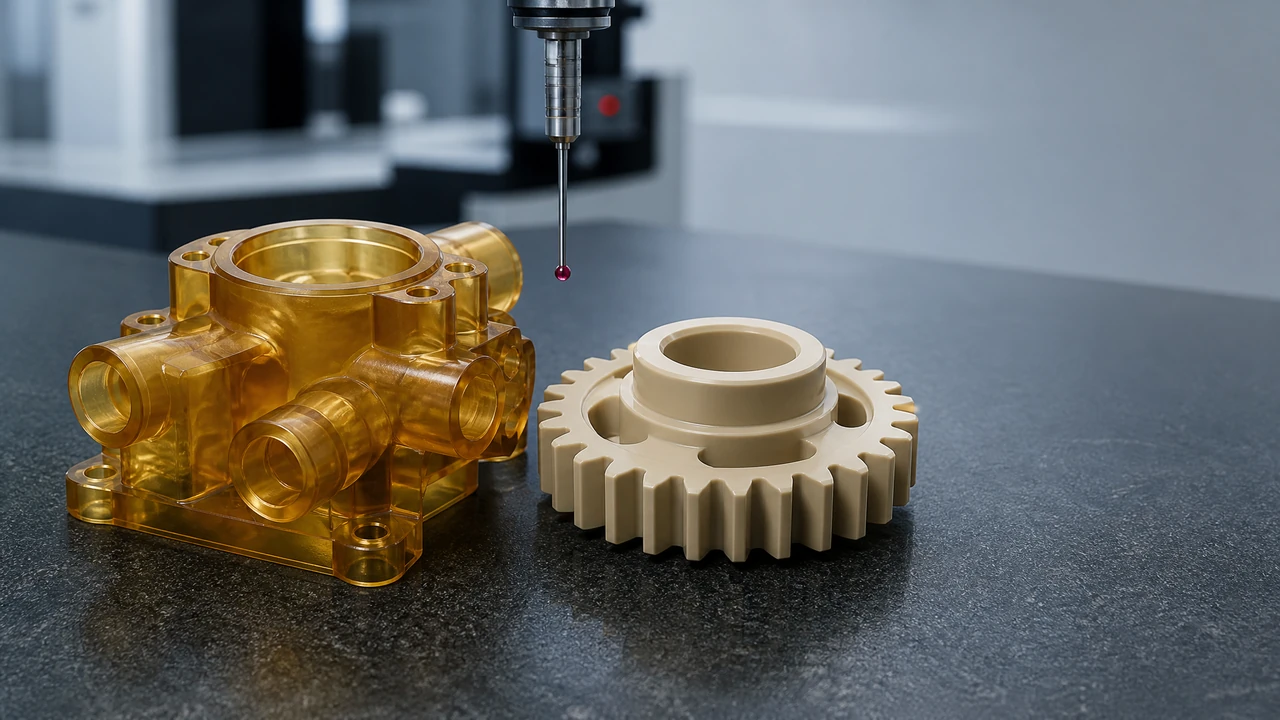
- Choose Ultem if: You need high dielectric strength (electrical insulation), transparency (Ultem is amber-transparent), or high stiffness at a lower price point for industrial manifolds.
5. FAQ: Precision Plastic Machining
Q: Does PEEK require specialized inspection?
A: Yes. Because PEEK is slightly compliant, contact-based measuring (like traditional calipers) can slightly compress the material. JXD uses CMM (Coordinate Measuring Machine) with low-force probes or optical measurement to ensure the ±0.005mm reading is absolute.
Q: Can PEEK or Ultem be glass-filled?
A: Both materials come in 30% Glass-Filled (GF30) versions. This increases stiffness and thermal stability but makes them extremely abrasive. JXD uses diamond-coated tooling for all GF30 projects to maintain surface finish (Ra 0.8 or better).
Q: What is the typical lead time for custom PEEK parts?
A: For prototyping (1-10 pcs), JXD offers a 7–14 day lead time. For critical aerospace or medical projects, we can provide FAI (First Article Inspection) reports and material MTRs upon request.
6. Conclusion: The Decision Tree
If your design specifies a high-performance polymer but the material is not yet locked, ask yourself: Does it touch the human body or harsh chemicals? If yes, go PEEK. Is it an internal structural component needing high stiffness at 150°C? Go Ultem.
Ready to Quote your PEEK or PEI Project?
JXD Machining specializes in high-precision plastic components for the medical and semiconductor industries. Upload your STEP files today for a DFM review.
Related Reading:
 Portuguese
  English
  German
  Italian
  Russian
  Spanish
  Turkish
  French