If you have ever moved a CNC part from prototype to production, you already know the moment everything can go wrong. The sample was perfect. The first article inspection passed. Then the purchase order grows from 10 pieces to 1,000 — and suddenly the lead time stretches, the delivery dates slip, and your own production line is left waiting.
For procurement managers and design engineers sourcing precision machined parts, batch production is rarely a question of “can you make it?” Most qualified suppliers can. The real question is harder: Can you make it on time, at volume, again and again, without surprises?
At Jingxinda (Xiamen) Precision Technology(JXD Machining), lead time reliability and capacity stability are not marketing claims — they are the operating system of our factory. In this article, we break down the most common batch production problems buyers face, and exactly how we solve them: with a 7-day production lead time, a 5-day reorder turnaround, and a flexible capacity model that scales from a single prototype to full mass production.
| Order Type | Quantity | Typical Lead Time | Deliverables |
|---|---|---|---|
| Rapid Prototyping | 1 – 10 pcs | 3 – 7 Days | Inspection Report |
| Small Batch | 10 – 100 pcs | 7 – 14 Days | FAI + Dim Report |
| Mass Production | 100 – 5000+ | 21+ Days | COC + Material Cert |
The Real Problem: Why Batch Production Breaks Down
Before we explain our solution, it helps to name the problem precisely. In CNC machining, batch production failures almost never come from the machine being unable to cut the part. They come from scheduling, capacity, and process control breaking down once volume increases.
Here are the four failure modes buyers report most often when they switch suppliers:
1. The “prototype-to-production” cliff
A supplier delivers a flawless prototype in days, wins the order, then quietly takes weeks to deliver the production batch. The prototype was machined by a senior operator with full attention; the batch was pushed to the back of a crowded queue. The buyer’s project timeline — already committed to their customer — absorbs the damage.
2. Lead times that grow with quantity
Many shops quote a fixed lead time for small orders but have no real model for scaling it. Order 50 pieces, get 10 days. Order 500, and the answer becomes “we’ll let you know.” For a procurement team trying to plan inventory and production, an unpredictable lead time is almost as bad as a long one.
3. Reorders treated like brand-new jobs
You approved the part. You ran it. You need more. Yet the reorder goes through the entire setup, programming, and first-article cycle again — as if the supplier had never made it before. Repeat business should be faster, not a restart.
4. Capacity that can’t flex
Some shops are built for one-offs and choke on volume. Others are tooled for mass runs and won’t touch a batch of 5. Buyers are forced to maintain two supply chains: one for prototypes, one for production — doubling qualification work, paperwork, and risk.
Every one of these problems has the same root cause: a factory that has not engineered its lead time and capacity as a system. That is exactly what we have done.
Our Solution: Lead Time as an Engineered Commitment
We treat delivery dates the way we treat tolerances — as a specification to be controlled, measured, and held. Here is how our batch production model actually works.
A 7-day production lead time, by design
Our standard CNC production lead time is 7 days — and critically, this is true whether you are ordering a prototype or a production batch. The prototype is not a special favor that disappears when the order scales; it runs through the same disciplined workflow as the production run behind it.
This matters because it removes the single most painful surprise in CNC sourcing: the prototype-to-production cliff. When the sample takes 7 days and the batch also takes 7 days, your project plan stops being a guessing game.
How do we hold 7 days consistently?
- Programming and tooling are prepared in parallel, not in sequence. While material is being staged, our engineering team finalizes CAM programs and fixturing, so machine time is never lost waiting on upstream steps.
- Dedicated production scheduling. Orders are slotted into a managed queue with capacity reserved in advance, instead of being squeezed into whatever gap appears.
- Multi-axis efficiency. Our 5-axis machining capability lets us complete complex geometries in fewer setups. Fewer setups mean fewer re-fixturing steps, fewer error points, and a shorter, more predictable path from raw material to finished part.
A 5-day reorder lead time — because repeat orders should be faster
When you reorder a part we have already produced, your lead time drops to 5 days.
This is possible because we retain everything from your first run: the validated CAM program, the fixturing setup, the inspection plan, and the material specification. A reorder does not restart the engineering clock — it reactivates a proven, locked-in process. For buyers running ongoing production, this turns Jingxinda into a dependable extension of their own supply chain, where replenishment is fast and predictable rather than a fresh negotiation every time.
Flexible capacity: from 1 piece to full production
Our minimum order quantity is 1 piece.
That is not a typo, and it is central to how we solve the “two supply chains” problem. With us, the supplier who machines your single prototype is the same supplier who machines your production batch — same equipment, same quality system, same team. You qualify one vendor, not two. The transition from validation to volume carries no re-qualification risk, because nothing about the source changes.
On the upper end, our maximum batch size is deliberately flexible. Rather than publishing a single capacity number that would be misleading, we scope each batch to the realities of the part: its size, geometry, material, and finishing requirements all affect how much we can run in a given window. A compact aluminum bracket and a large, hard-material structural component place very different demands on machine time. So instead of a one-size-fits-all promise, we give every customer a capacity assessment specific to their part — an honest, achievable volume and schedule, confirmed before you commit.
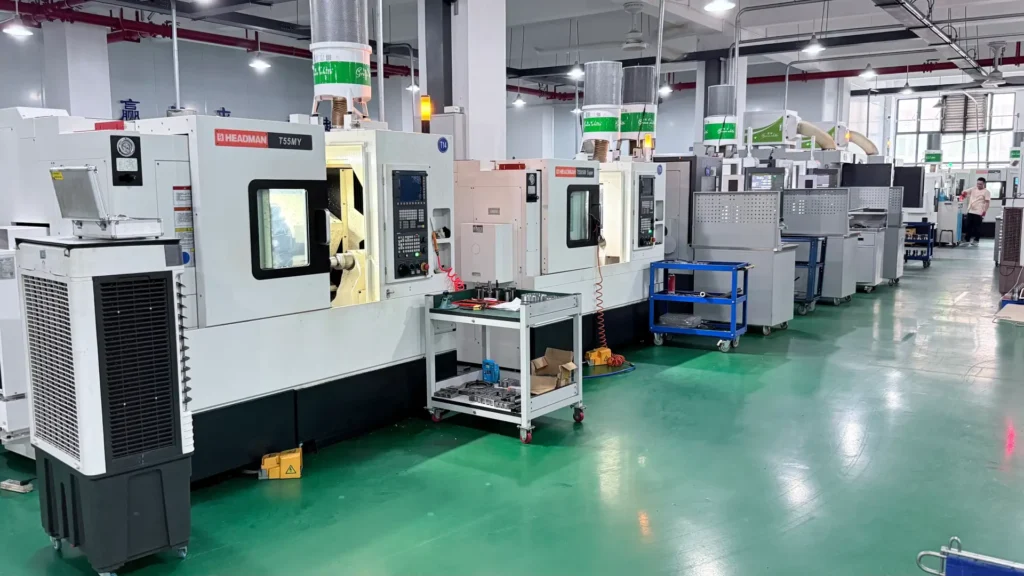
This flexibility is backed by real infrastructure: a 4,410 m² facility running 14 production lines, which gives us the headroom to absorb volume increases without pushing your delivery date.
The Foundation: Why Our Lead Times Are Trustworthy, Not Just Fast
Fast lead times mean nothing if the parts arrive wrong. The reason we can commit to aggressive schedules is that our quality system is built to prevent rework — and rework is the hidden killer of every delivery date.
Process control that scales with the batch
A 7-day promise on part #1 is worthless if part #500 drifts out of tolerance and the whole run has to be re-machined. We engineer consistency into the batch from the start:
- 5-axis machining for repeatability. Completing parts in fewer setups doesn’t just save time — it eliminates the cumulative error that creeps in every time a part is re-clamped. The 500th piece is held to the same standard as the first.
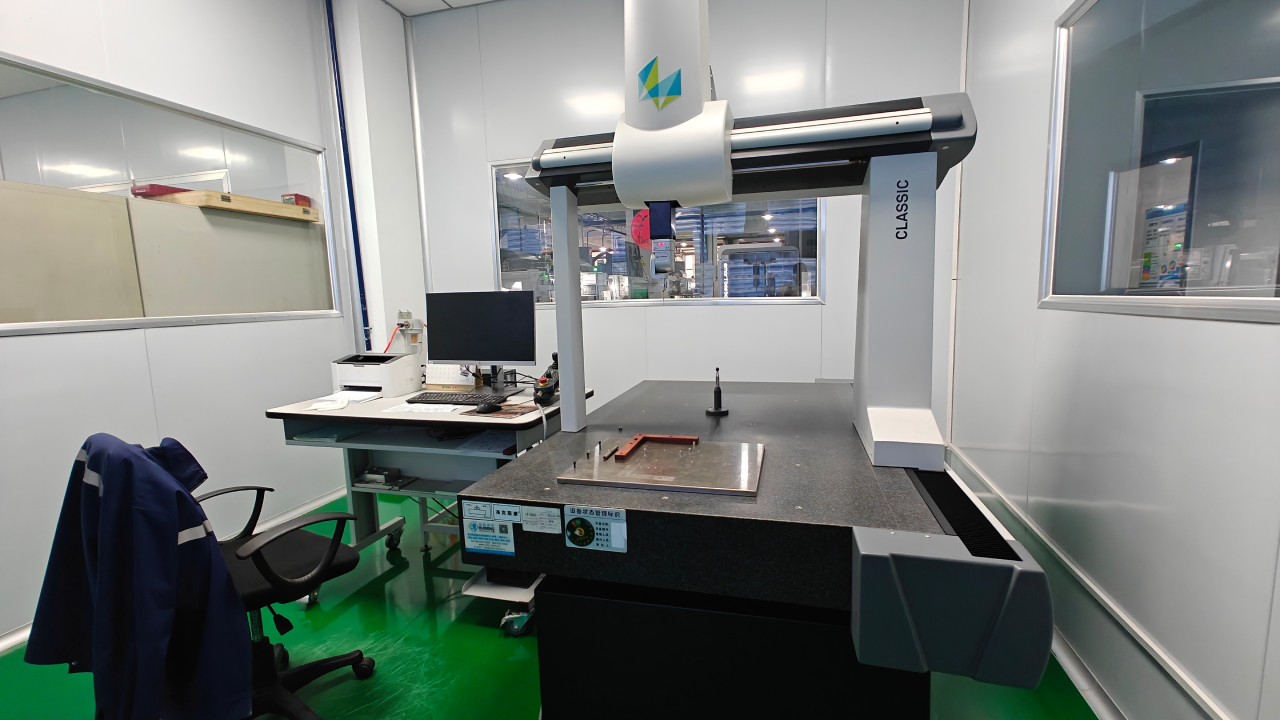
- In-process inspection. We check parts during the run, not only at the end, so any deviation is caught and corrected before it becomes a batch-wide problem and a schedule-wrecking re-do.
- Locked, documented processes. Once a part is validated, its program, fixturing, and inspection criteria are recorded — which is precisely what enables our 5-day reorder turnaround.
TÜV Rheinland certification
Our quality management is verified by TÜV Rheinland, the German certification body. For a procurement team, this is more than a logo — it is independent assurance that our processes are documented, audited, and repeatable. Repeatable processes are what make a lead time a commitment rather than a hope.
What This Means for You as a Buyer
Let’s translate our manufacturing model into the outcomes you actually care about.
The combined effect is predictability. You can commit dates to your own customers. You can plan inventory with confidence. You can scale a product without re-sourcing. In B2B precision manufacturing, that predictability is worth more than any single fast quote.
Frequently Asked Questions
What is your standard lead time for CNC batch production? Our standard production lead time is 7 days, which applies to both prototype and production batches. Reorders of previously validated parts ship in 5 days.
What is your minimum order quantity (MOQ)? Our MOQ is 1 piece. The same factory, equipment, and quality system serve both your prototype and your full production run.
What is your maximum batch capacity? Maximum batch size depends on the specific part — its dimensions, material, and finishing needs all affect throughput. We provide a capacity assessment tailored to your part before you order, so the volume and schedule we quote are realistic and achievable. Our facility runs 14 production lines across 4,410 m².
How do you keep quality consistent across a large batch? We use 5-axis machining to minimize setups and cumulative error, perform in-process inspection during the run, and operate under a TÜV Rheinland-certified quality management system. Validated parts also have locked, documented processes that ensure every reorder matches the original.
What industries do you serve? Our precision CNC machining serves any industry requiring tight-tolerance components — including automotive, medical, robotics, electronics, and industrial equipment.
Can you machine difficult materials? Yes. Material selection affects throughput and is factored into your part-specific capacity assessment. Share your material and drawings and we will confirm feasibility and lead time.
Stop Letting Lead Times Run Your Schedule
Batch production should make your life easier, not introduce new risk into your supply chain. With a predictable 7-day production lead time, a 5-day reorder turnaround, an MOQ of 1, and flexible capacity backed by 14 production lines and TÜV Rheinland-certified quality, Jingxinda (Xiamen) Precision Technology is built to be the supplier you don’t have to worry about.
Ready to see how fast your part can ship?
Send us your drawings (STEP, IGES, or PDF) and target quantity. We’ll respond with a part-specific quote, an honest capacity assessment, and a firm lead time — so you can plan your project with certainty.
👉 Send your inquiry today and get a quote with a confirmed delivery date. ith a confirmed delivery date.
 English
  German
  Italian
  Russian
  Spanish
  Turkish
  French
  Portuguese