
The Bottom Line: In the medical device industry, “close enough” does not exist. Whether it is a surgical instrument, a bone screw, or a housing for a diagnostic device, the requirement is absolute precision. Machining components for the medical sector demands more than just high-end machines; it requires a deep understanding of biocompatible materials and the ability to hold tolerances as tight as ±0.005 mm (0.0002”).
Choosing the Right Biocompatible Materials
| Материал Градация | Key Property | Typical Medical Application | Machining Challenge |
|---|---|---|---|
| Titanium Ti-6Al-4V ELI | Excellent strength-to-weight, biocompatible | Surgical implants, bone screws | Poor thermal conductivity; requires high-pressure coolant |
| Stainless Steel 316L | Superior corrosion resistance | Surgical tools, endoscopic components | High work-hardening rate; requires sharp carbide tools |
| PEEK (Medical Grade) | Radiolucent, high chemical resistance | Spinal cages, cranial implants | Thermal expansion; requires multi-stage annealing cycles |
Mastering Micro-Machining: The Power of Swiss-Type Lathes
Many medical parts, such as dental implants or vascular stents, are incredibly small. JXD utilizes Swiss-type CNC machining to solve this. By supporting the workpiece with a guide bushing right at the point of cutting, we eliminate vibration and deflection. This allows us to produce long, thin medical components with surface finishes of Ra 0.4 μm or better.
Quality Validation & Traceability
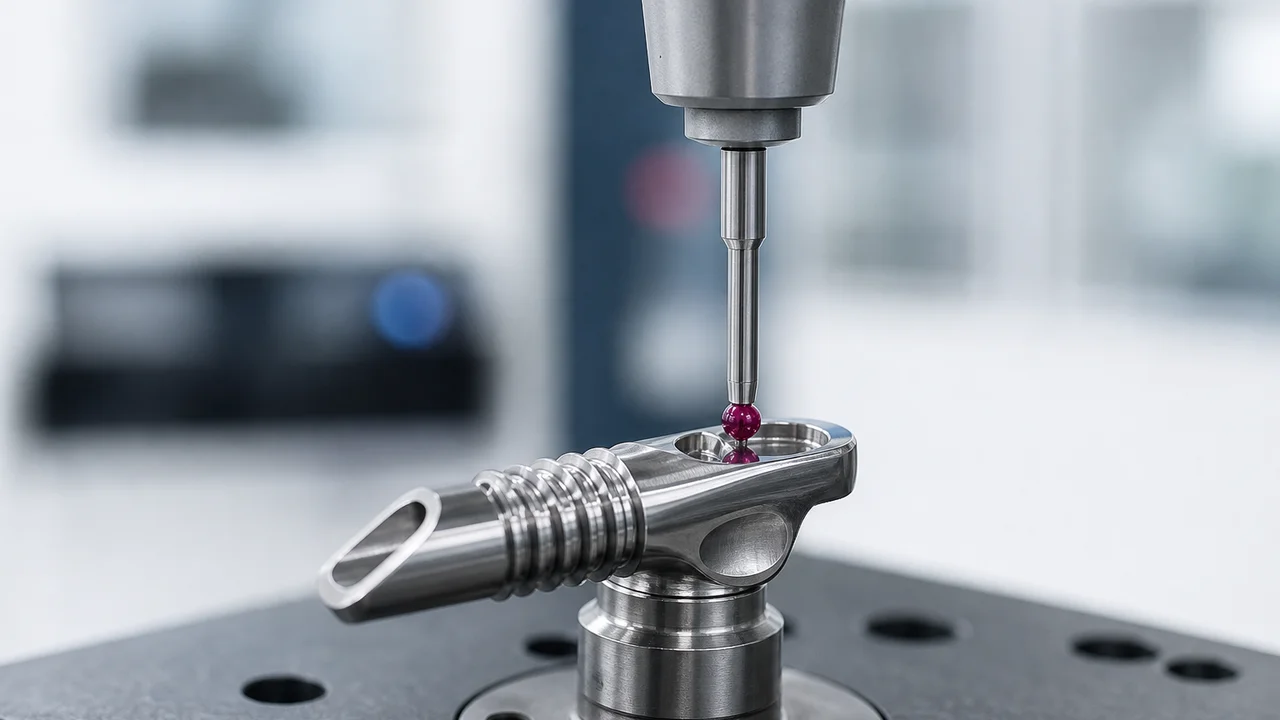
For a medical procurement engineer, the paperwork is as important as the part. Every medical component produced at JXD goes through a documented validation workflow: Material Test Reports (MTR), Certificates of Conformance (CoC), and full CMM Inspection.
Post-Machining: Ultrasonic Cleaning & Passivation
Machining is only half the battle. For medical devices, the removal of cutting fluids, micro-burrs, and metallic contaminants is critical to ensure biocompatibility and prevent adverse tissue reactions.
- Multi-Stage Ultrasonic Cleaning: We utilize specialized cleaning lines to remove residual oils and particulates from complex geometries and internal micro-channels.
- Passivation (ASTM A967/A380): For stainless steel components, we perform nitric or citric acid passivation to restore the protective oxide layer, ensuring maximum corrosion resistance in biological environments.
- Inspection Under Magnification: Every part undergoes visual inspection at 10x-20x magnification to ensure the surface is free of embedded contaminants or process residuals.
DFM Advice for Medical Device Design
- Avoid Internal Sharp Corners: Use a radius (even 0.1mm) to allow tool entry.
- Optimize Thread Selection: Avoid extremely fine pitches for micro-screws to prevent cross-threading.
- Specify Critical Tolerances Only: While we can achieve ±0.005 mm, over-specifying non-critical surfaces increases costs.
Looking for a reliable medical CNC machining supplier? Upload Your 3D Drawings today for a technical review. Explore our Услуги ЧПУ (числовое программное управление) обработки to see our full capability.
 Russian
  English
  German
  Italian
  Spanish
  Turkish
  French
  Portuguese