


A fast-sounding CNC machining lead time is not a reliable schedule until the supplier states what the clock starts from, which requirements are confirmed, and which dependencies remain open. Drawing revision, material condition, tolerances, surface finish, outside processing, inspection documents, packaging, and approval timing can all change the plan.
For a buyer with a real part, predictable lead time does not mean an unconditional number of days. It means the supplier identifies the inputs, milestones, assumptions, and change points that control the schedule. Good engineering communication turns an uncertain date into a plan that both sides can review.
Why speed claims do not make lead time predictable
“Fast delivery” or “quick turnaround” does not answer when production planning starts, whether the drawing revision is approved, whether material is available, whether tolerances and datums are clear, whether outside processing is required, which inspection documents are needed, who approves a clarification, or what happens when scope changes. A schedule becomes easier to understand when these questions are answered before production release.
What predictable CNC machining lead time actually means
A useful lead-time response connects a schedule to defined events: RFQ receipt, drawing and CAD review, open-question resolution, quote scope confirmation, drawing or purchase-order approval, material availability, machining start, outside processing, inspection and document review, packaging, and shipment. A date measured from RFQ receipt is different from one measured from approved drawing and material availability.
Predictability is a control system, not a fixed-day claim
| Schedule question | What a clear response should identify | Buyer action |
|---|---|---|
| Start event | RFQ receipt, approval, material arrival, or another milestone | Confirm the controlling event |
| Technical status | Revision, CAD match, open questions, DFM status | Resolve each question |
| Material dependency | Grade, condition, availability, substitutions, records | Approve alternatives |
| Process dependency | Milling, turning, setup, workholding, inspection access | Confirm the proposed route |
| Outside processing | Finish, heat treatment, plating, anodizing, passivation | Ask who owns timing |
| Quality dependency | Inspection scope, report format, sampling, approval | Define shipment acceptance |
| Change control | Effect of revision, quantity, finish, or inspection changes | Require an updated assumption |
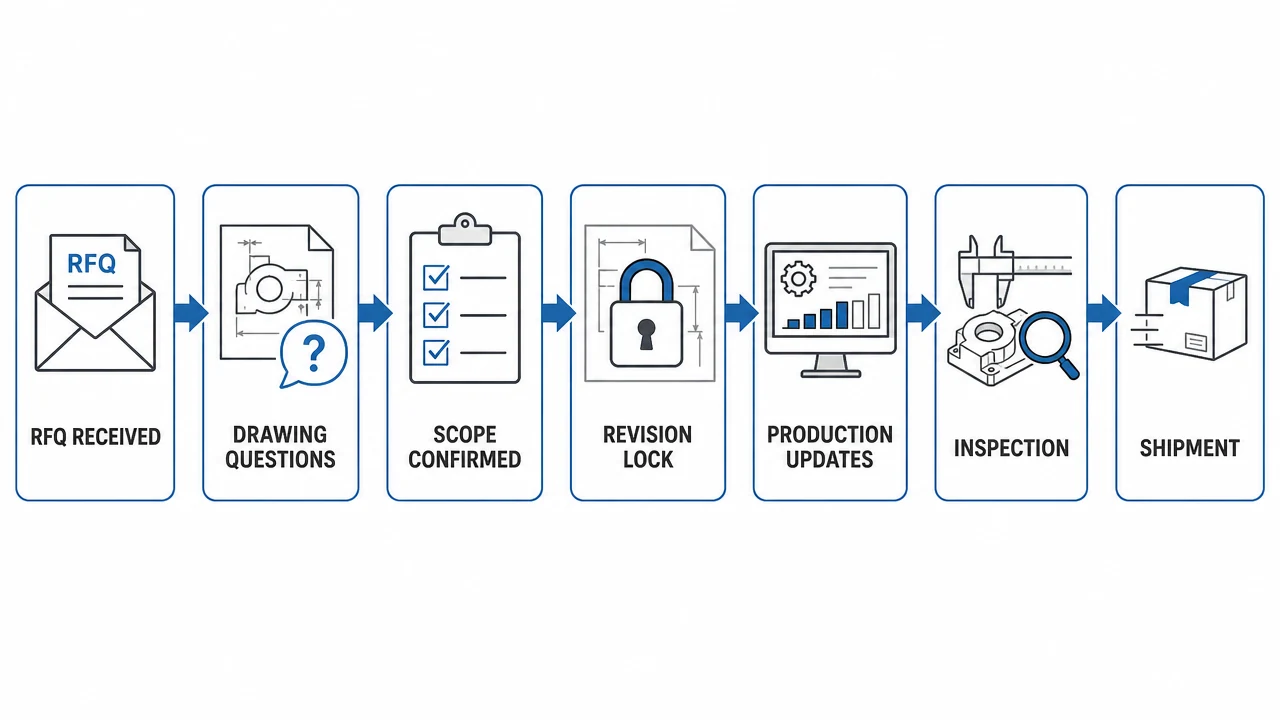
Educational workflow: RFQ received, drawing questions, scope confirmed, revision locked, production updates, inspection, and shipment.
Drawing and CAD review: the first communication checkpoint
The first engineering exchange should confirm that the supplier is reviewing the same part definition as the buyer. Send a controlled 2D drawing and matching 3D CAD model, and ask the supplier to identify any conflict rather than silently choosing one file.
- Part number and current revision
- 2D drawing and 3D model consistency
- Units, general tolerances, datums, CTQs, fits and position requirements
- Threads, holes, deep pockets, thin walls, small radii and tool access
- Surface finish, masking, post-processing and inspection method
- Superseded or provisional files
For the buyer-side file package, see the CNC machining drawing package checklist. For feature-level detail, see the threaded hole callout guide.
Material, tolerance, and surface-finish confirmation
Material, tolerance, and finish influence process planning, inspection, outside processing, and acceptance. Confirm exact grade and condition, substitution approval, traceability, general versus critical tolerances, datum relationships, and whether dimensions are checked before or after finishing. State masking, keep-out areas, cosmetic surfaces, critical fits, and who approves finish clarifications.
Use the flatness versus parallelism guide for terminology; it does not replace the controlled drawing or acceptance plan.
What useful DFM feedback looks like
“DFM review available” is not enough. Useful feedback connects a specific feature to a manufacturing reason, a risk, a proposed clarification, and a buyer decision.
| Issue observed | Reason to clarify | Schedule or quality risk | Useful communication | Buyer decision |
|---|---|---|---|---|
| Thin wall near a clamp | Workholding or tool force | Deformation or rework | Identify feature and proposed support/sequence | Approve, revise, or record intent |
| Deep pocket, limited access | Tool reach, deflection, chips, inspection | Extra setup or measurement difficulty | State access concern and review point | Confirm route or method |
| Tight fit on finished surface | Finish thickness affects size | Rework or fit risk | Clarify pre- and post-finish dimensions | Define acceptance stage |
| Model and drawing disagree | CAM and inspection need one definition | Wrong revision or late clarification | Identify conflict and stop assumption | Release controlled answer |
| Critical datum lacks method | Measurement setup is unclear | Approval delay or dispute | Ask for setup and measurement method | Approve or revise requirement |
Good DFM feedback is specific enough for a buyer to decide. It should not silently redesign the part or create an unauthorized tolerance. See the CNC machining supplier qualification checklist for broader evidence context.
Quote assumptions: define the schedule before quoting
A quote should state assumptions behind both price and timing. Otherwise suppliers may quote different scopes.
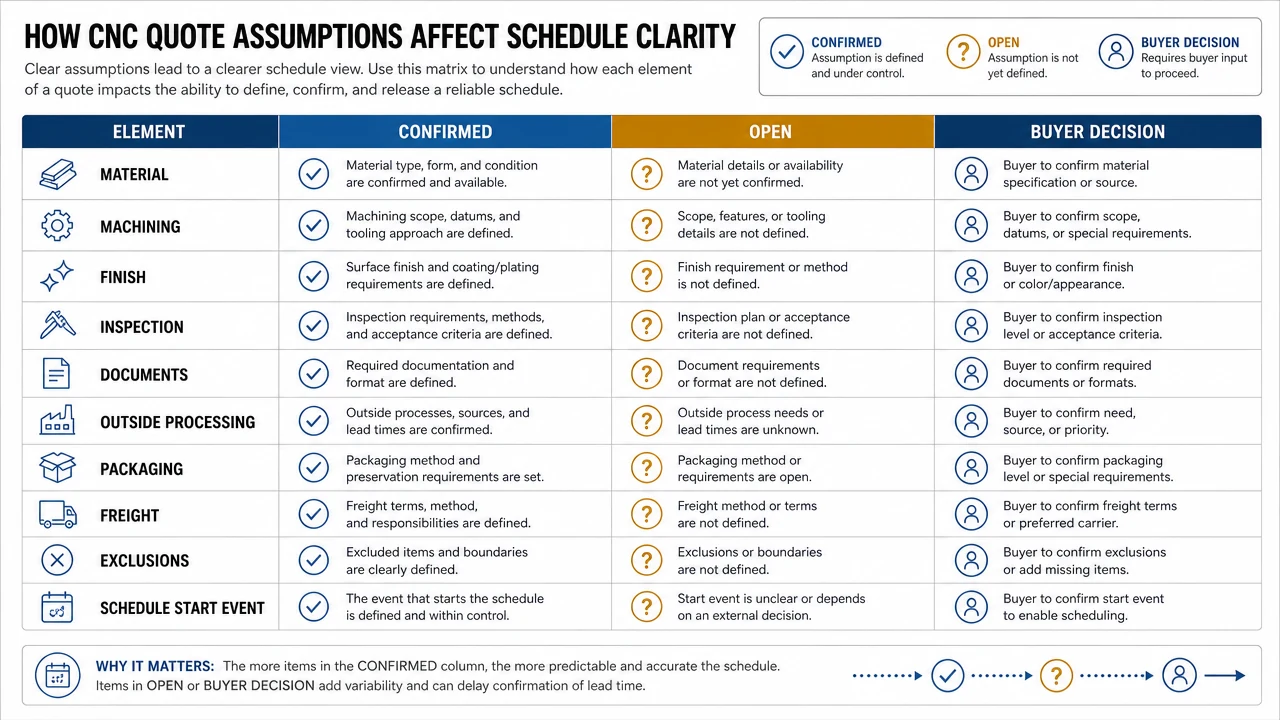
Educational matrix showing how material, finish, inspection, outside processing, packaging, and the schedule start event affect quote clarity.
| Quote item | Confirm before approval | Why it affects schedule |
|---|---|---|
| Materiale | Grade, condition, availability, records | Sourcing and arrival may control start |
| Machining | Route, setup assumptions, feature risks | Geometry and access affect planning |
| Tooling/setup | Fixture, programming and one-time work | Preparation can move production start |
| Fine | Process, masking, color, thickness, processor | External dependency and approval |
| Inspection | CTQs, method, sampling, report timing | Scope affects release criteria |
| Documents | MTR, CoC, FAI, CMM, finish record | Records may need review |
| Packaging/freight | Protection, labels, destination, logistics basis | Final operation and delivery basis |
| Exclusions | Open and provisional items | Unlisted work becomes a late change |
| Schedule start | Approval, material arrival, or milestone | Dates cannot compare without a basis |
Quality documents and inspection evidence
Inspection documents should be linked to project requirements, not used as generic proof that every risk is controlled. Different records answer different questions.
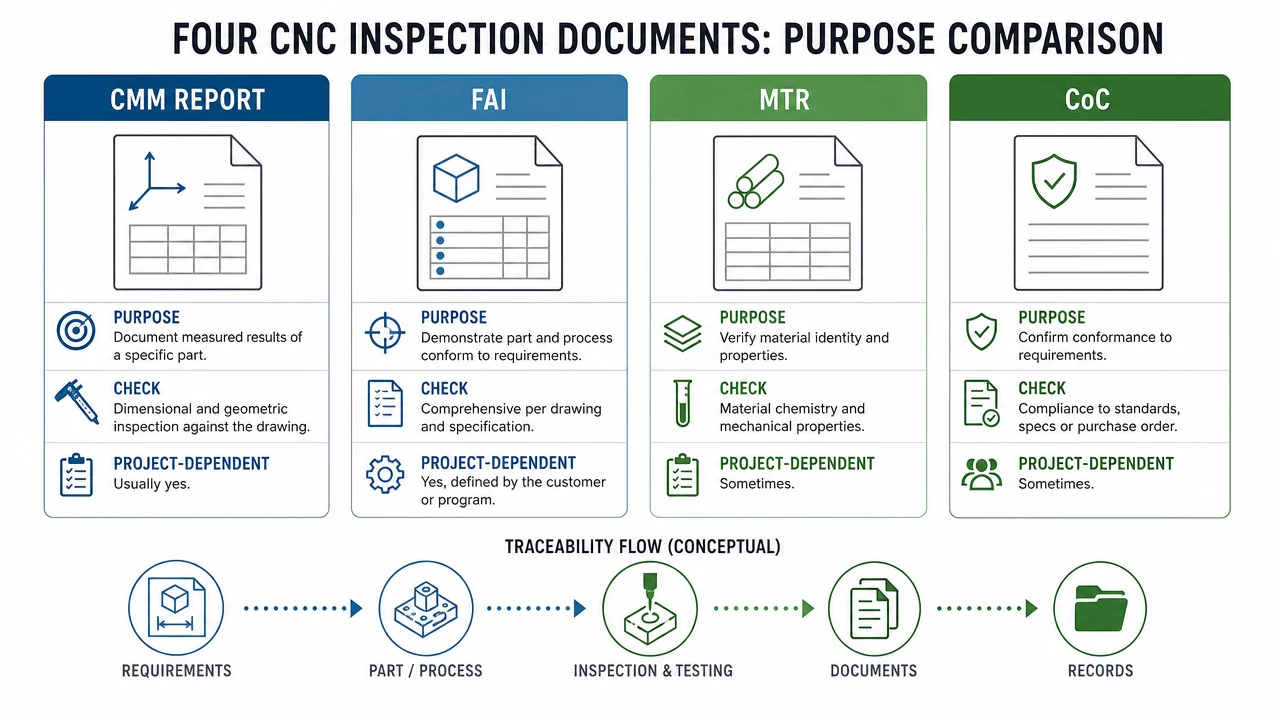
Educational comparison of common CNC quality documents and the different questions each may help answer.
| Document | What it can help verify | What the buyer should confirm |
|---|---|---|
| Dimensional report | Selected dimensions and characteristics | Scope, method, sample, revision, units, criteria |
| CMM report | Coordinates or GD&T when setup is defined | Datum frame, balloons, quantity, drawing revision |
| FAI record | First-part verification to agreed requirements | Coverage, revision, material, process state, deviations |
| MTR | Material identity and supplied information | Grade, condition, lot/heat traceability and project match |
| CoC | Supplier conformity statement | Part, revision, quantity, requirements, traceability |
| Finish record | Specified treatment or finish evidence | Scope, masking, lot/batch and acceptance information |
See How to Read a CMM Inspection Report e JXD quality assurance and inspection capabilities. Confirm which document is required, when it is produced, who reviews it, and whether shipment waits for approval.
Communication checkpoints from RFQ to shipment
Use a defined sequence so both sides know what is decided and what remains open.
- RFQ received: confirm files, part, revision, quantity, material, finish, inspection, and delivery window.
- Drawing questions: list conflicts, datums, CTQs, access, finish assumptions and measurement questions, with an owner for each answer.
- Scope confirmed: confirm machining, finishing, inspection, documents, packaging, freight and one-time charges.
- Quote assumptions issued: identify the schedule start event, dependencies, exclusions and timing conditions.
- Approval and revision lock: record price and timing effects before a change proceeds.
- Production updates: distinguish completed machining from outstanding outside processing or inspection.
- Inspection and document review: provide agreed records against the correct part and revision.
- Packaging and shipment: confirm final inspection/document status, packaging basis, shipping assumption and traceable changes.
Milling versus turning: why process choice changes the questions
CNC milling and turning use different geometries, setups, workholding and inspection priorities. For milling, ask about multi-sided access, datums, deep pockets, thin walls, tool reach, marks and inspection access. For turning, ask about stock diameter, chucking or collet assumptions, concentricity, runout, shoulders, bores, threads, grooves and secondary milling.
Use CNC milling services e CNC turning services for process context. There is no universal faster process; the actual route and dependencies control the schedule.
Buyer checklist before approving a CNC quote
Mark each item confirmed, open, or not applicable.
- ☐ Part number and current revision are identified.
- ☐ Controlled 2D drawing and matching 3D CAD were reviewed.
- ☐ Model-to-drawing conflicts are resolved.
- ☐ Datums, fits, CTQs and tolerance relationships are understood.
- ☐ Threads, holes, thin walls, deep features and access risks are addressed.
- ☐ Material grade, condition and substitution rules are clear.
- ☐ Surface finish, masking, post-processing and inspection stage are defined.
- ☐ Dimensional, CMM, FAI, MTR, CoC and finish records are listed as needed.
- ☐ Report scope, sample size, revision and acceptance criteria are defined.
- ☐ Machining, tooling, setup and outside-processing ownership are clear.
- ☐ Packaging, freight, exclusions and provisional items are stated.
- ☐ Lead-time start event and customer approvals are identified.
- ☐ Revision impact on price and schedule is explained.
- ☐ Open technical questions have owners and the approved revision is recorded.
- ☐ Milestone updates and inspection/document approval responsibilities are clear.
When to request a focused engineering review
Request a focused review when the model and drawing conflict; a critical feature lacks a datum or inspection method; tight tolerances affect a fit, seal, bearing or assembly interface; finish may change a critical dimension; material condition is unclear; geometry requires difficult access, thin-wall control, deep machining or several setups; documents are undefined; or revision, quantity, finish or delivery requirements changed after the quote.
Submit a controlled RFQ package
Have a real CNC project to review? Send the current 2D drawing and 3D CAD model with material grade, quantity, critical tolerances, surface finish, inspection/document requirements, packaging needs and requested delivery window through the JXD Contact/RFQ page. This does not promise a fixed lead time; it makes the basis of the schedule clearer.
FAQ
What information affects CNC machining lead time most?
Drawing revision, geometry and setup, material grade and condition, tolerance and inspection scope, finish or outside processing, quantity, packaging, shipping assumptions and buyer approvals. Ask which controls the quoted start event.
Why review both the 2D drawing and 3D CAD model?
The model communicates geometry while the controlled drawing commonly carries dimensions, tolerances, datums, notes, material, finish and inspection requirements. Reviewing both exposes mismatches before machining or inspection planning.
How do material, tolerance, and surface finish change the schedule?
Availability can affect the start event; critical tolerances can require setup or inspection planning; treatments can add outside processing, masking, approval and post-finish checks. The supplier should state project-specific assumptions.
What should a CNC machining quote state about lead time?
It should state the start event, quantity, material and finish assumptions, inspection/document scope, outside processing, approvals, packaging/freight basis, exclusions and how changes affect the date.
Which inspection documents should I request?
Request records matching the acceptance plan: dimensional or CMM report, FAI, MTR, CoC or finish record. Define features, sample size, revision, format and approval timing instead of an undefined “full inspection report.”
Does CNC milling or turning usually have a shorter lead time?
There is no universal answer. Geometry, stock, workholding, setup count, secondary operations, material, finish, quantity and inspection can matter more than the process label.
How can engineering communication reduce delivery risk?
It makes revision, questions, material and finish assumptions, inspection scope, approval owners, outside processing and change effects visible before production. It gives both teams a traceable basis for updating the plan.
CTA
Have a drawing or CAD project with a schedule that needs to be understood? Send the controlled RFQ package to JXD with the current revision, material, quantity, tolerances, finish, inspection requirements, packaging needs and requested delivery window for engineering review.
 Italian
 English
 German
 Russian
 Spanish
 Turkish
 French
 Portuguese