
PEEK is usually the safer choice when a CNC-machined polymer part must survive aggressive chemicals, repeated wear, or sustained high-temperature service. Ultem—SABIC’s trade name for PEI—often makes more sense when the application needs dimensional predictability, electrical insulation, inherent flame resistance, and a lower material budget.
That does not make PEEK universally better. Specifying PEEK for a moderate-temperature static housing can add material and machining cost without improving function. Specifying Ultem for a sliding component exposed to an incompatible solvent can create a premature failure that no machining tolerance will fix.
The correct decision starts with the exact grade, operating environment, load case, and inspection requirement—not the generic material family name.
The Short Answer: Choose by Failure Mode
Use PEEK when failure is most likely to come from heat, chemical exposure, friction, fatigue, or repeated thermal cycles for which the selected grade is qualified. Use Ultem when failure is more likely to come from dimensional change, electrical breakdown, flammability requirements, or an unnecessarily expensive material choice.
For CNC machining, compare unfilled PEEK with unfilled ULTEM 1000 unless your drawing specifies a reinforced grade. Glass-filled and carbon-filled formulations have different stiffness, thermal expansion, wear behavior, surface finish, and tool-abrasion characteristics. Mixing filled and unfilled datasheet values in one decision table can lead to the wrong material choice.
PEEK vs Ultem Comparison for Machined Parts
| Engineering factor | PEEK | Ultem / PEI |
|---|---|---|
| Polymer structure | Semi-crystalline | Amorphous |
| Thermal behavior | Higher continuous-service capability, grade dependent | The SABIC ULTEM family page cites a 217°C glass-transition temperature and relative thermal index values up to 180°C for relevant grades and configurations; use the exact grade datasheet and UL listing |
| Chemical resistance | Broad resistance to many aggressive environments; verify the exact fluid and temperature | Broad for an amorphous polymer, but compatibility must be checked for the exact chemical and stress state |
| Wear and friction | Preferred for bearings, seals, thrust washers, and sliding components | Better suited to static or low-wear components unless a modified grade is specified |
| Dimensional behavior | Crystallinity and internal stress require controlled machining and stock condition | Amorphous structure can provide predictable dimensional behavior when grade, stock condition, and geometry are controlled |
| Electrical applications | Good insulating performance, grade dependent | Strong fit for electrical insulators, connectors, test fixtures, and semiconductor handling components |
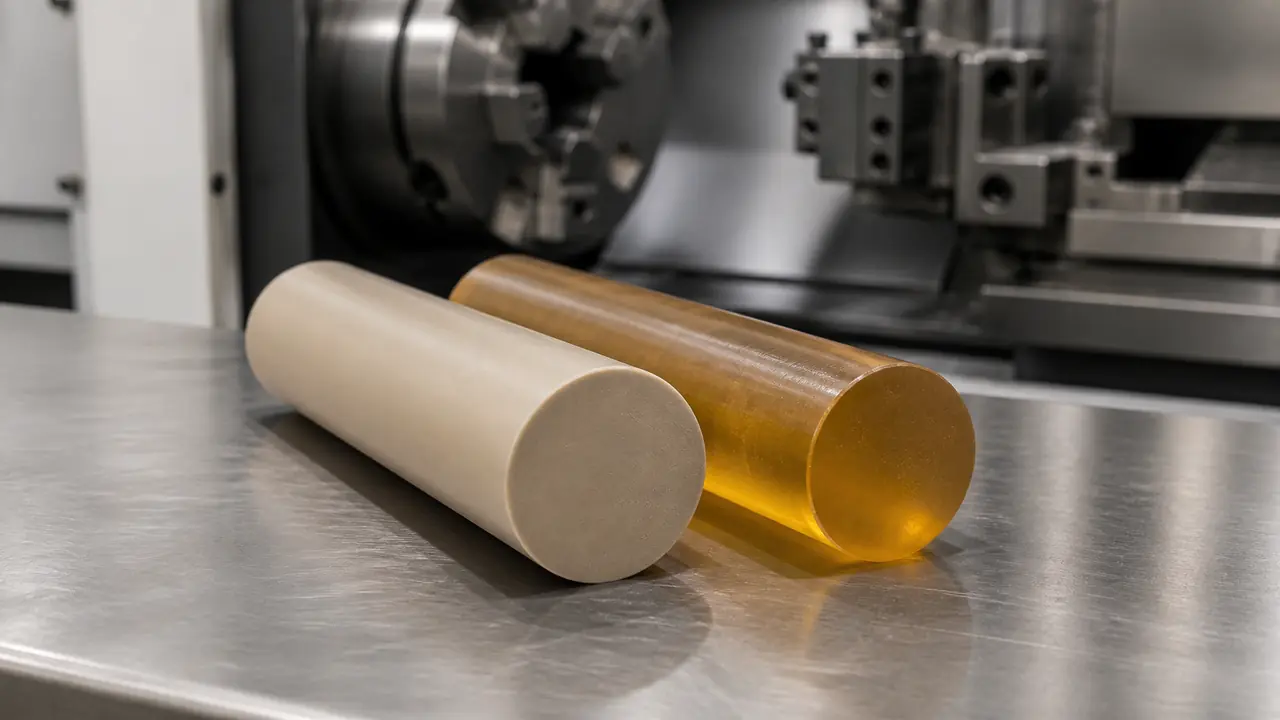
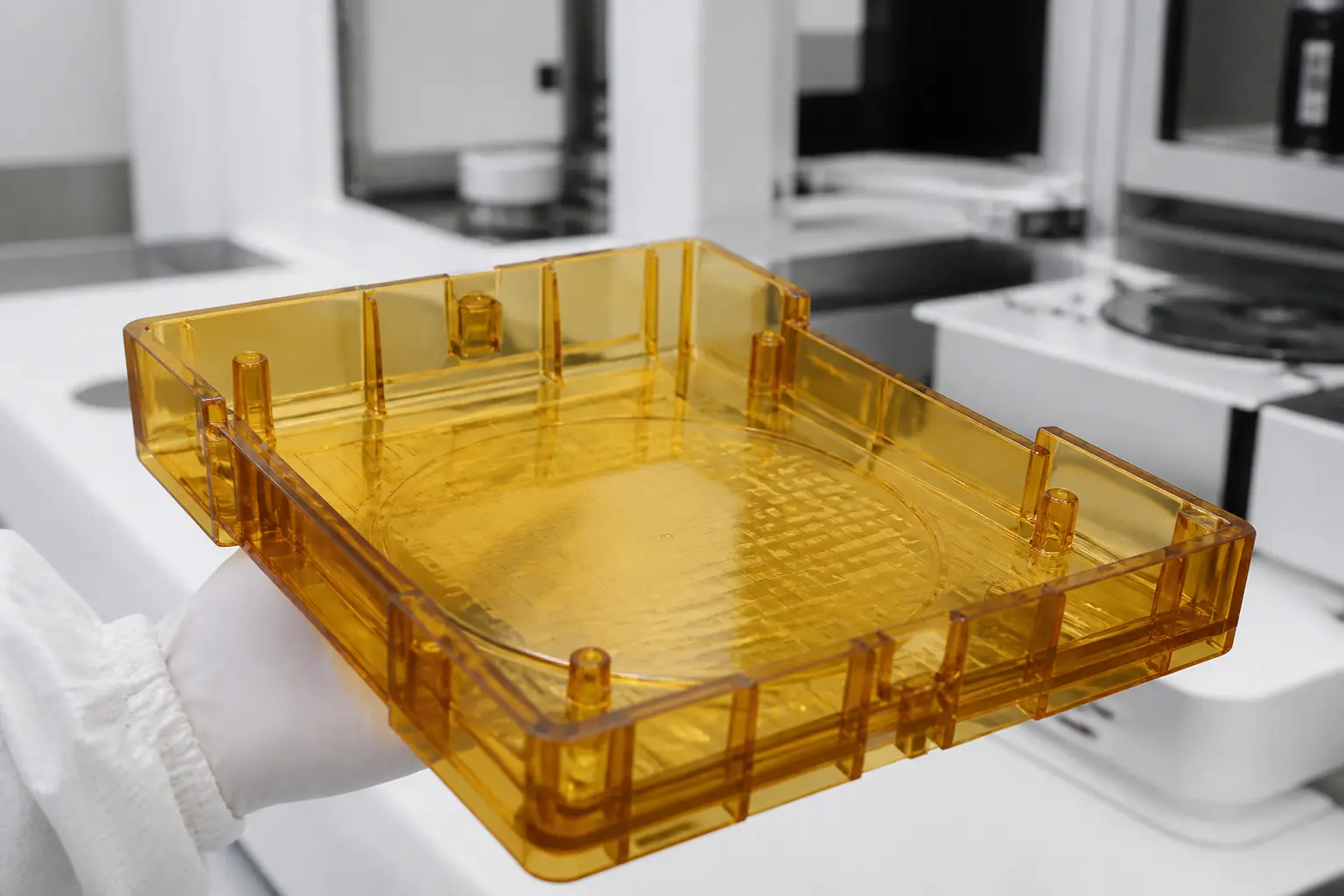
| Natural appearance | Typically opaque tan or gray | Natural ULTEM 1000 is transparent amber |
| Relative material cost | Higher | Lower than PEEK, but still a high-performance engineering plastic |
| CNC sourcing question | Is the performance requirement high enough to justify the material and machining cost? | Does the chemical, wear, and operating-temperature envelope remain within the selected grade’s verified limits? |
Property values vary by manufacturer, stock shape, reinforcement, color, conditioning, thickness, and test method. Use the supplier’s current grade-specific datasheet and applicable listing for final design calculations.
When PEEK Is the Better Choice
High-Temperature Parts with Mechanical Load
PEEK retains useful mechanical properties at temperatures where many engineering plastics soften or lose stiffness. JXD’s existing PEEK CNC machining page describes its use in aerospace, medical equipment, electronics, industrial machinery, and semiconductor manufacturing.
Choose PEEK when the part combines elevated temperature with mechanical load. Examples include valve seats, pump components, high-temperature insulators, bearing cages, seals, and process-equipment components.
Temperature alone is not enough. An electrical enclosure operating near a heat source may still favor Ultem if the load and chemical exposure are moderate. The decision should reflect the combined temperature, stress, time, and chemical environment.
Sliding, Wear, and Friction Components
PEEK is usually the stronger candidate for bushings, wear pads, seals, guides, and moving parts. Filled bearing-grade PEEK can further change friction and wear behavior, but it should not be treated as interchangeable with unfilled PEEK.
For a sliding component, send the supplier:
- mating material;
- surface finish of both interfaces;
- dry or lubricated condition;
- pressure and sliding speed;
- operating temperature;
- expected duty cycle; and
- allowable wear or clearance growth.
Without that information, “PEEK has good wear resistance” is not a design decision.
Aggressive Chemical Exposure
PEEK resists a broad range of chemicals, which is why it appears in semiconductor wet-process equipment, chemical processing, oil and gas, and repeated-cleaning applications. Compatibility still depends on concentration, exposure temperature, stress, and duration.
Do not approve PEEK from a generic compatibility chart alone. Verify the exact grade with the stock-shape supplier or resin manufacturer, especially when the part sees concentrated acids, solvents, steam, or combined mechanical stress. Victrex provides manufacturer information for PEEK and PAEK materials, but final approval should use the technical data and compatibility documentation for the selected grade.
When Ultem Is the Better Choice
Electrical and Semiconductor Components
SABIC describes ULTEM resin as a family of amorphous PEI materials with elevated-temperature strength, dimensional stability, electrical performance, and inherent flame resistance. The family page cites a 217°C glass-transition temperature and relative thermal index values up to 180°C for relevant grades and configurations. These values must not be treated as a universal continuous-use limit for every ULTEM part; verify the exact grade, color, thickness, test method, and applicable UL listing.
Ultem is often a practical choice for:
- electrical insulators;
- connector bodies;
- test sockets and fixtures;
- sensor housings;
- semiconductor handling components;
- equipment covers; and
- structural parts that need inherent flame resistance.
The natural amber color can also support visual inspection in some assemblies, although color should never replace material certification.
Tight-Tolerance Static Parts
Because Ultem is amorphous, it can offer predictable dimensional behavior when the stock condition, wall geometry, fixturing, and machining sequence are controlled. It is a strong option for static precision components that do not require PEEK’s higher wear or chemical performance.
This does not mean every Ultem part automatically holds tighter tolerances than PEEK. Thin walls, asymmetric material removal, internal stress, heat input, and inspection temperature can move either material.
When PEEK Would Be Over-Engineering
PEEK may be unnecessary when all of the following are true:
- Service temperature remains inside the selected Ultem grade’s verified range.
- The part does not face chemicals that are incompatible with the selected PEI grade.
- Wear and sliding friction are not primary failure modes.
- Electrical insulation, flame behavior, or dimensional stability matters more than maximum chemical resistance.
- The application accepts the selected Ultem grade’s color and documented regulatory status.
In that case, Ultem can reduce raw-material cost and simplify sourcing without sacrificing the required function.
CNC Machining Differences That Affect the Quote
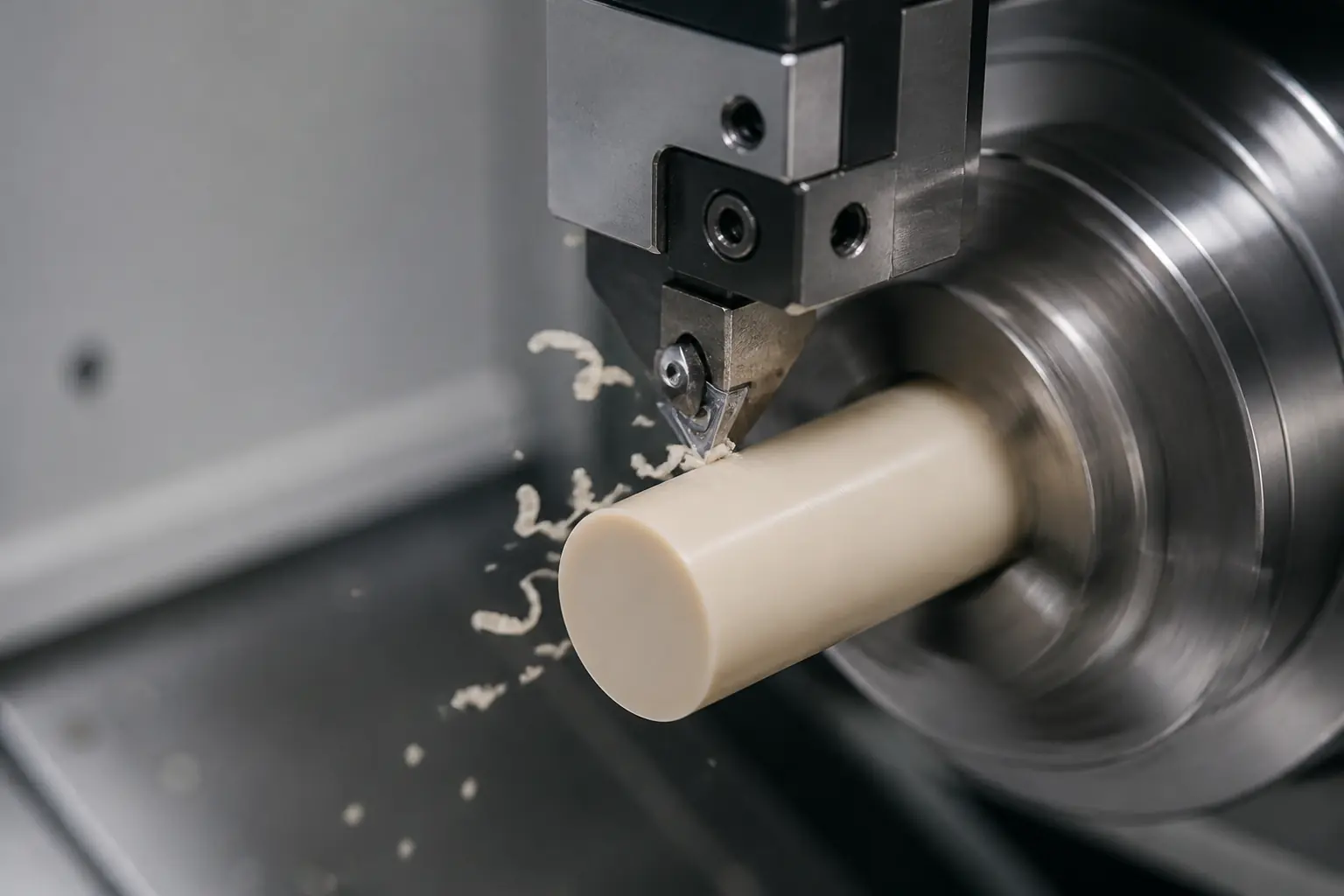
A Protolabs overview of PEEK and PEI also emphasizes that the material choice affects both manufacturing route and application fit. For a machined part, the quote depends on the exact grade, stock condition, geometry, tolerance, and inspection requirement.
Grade and Stock Shape Come First
An RFQ that says only “PEEK” or “Ultem” is incomplete. Specify:
- manufacturer and grade when controlled;
- unfilled, glass-filled, carbon-filled, or bearing grade;
- rod, plate, tube, or molded blank;
- natural or colored material;
- certificate and lot-traceability requirements; and
- whether substitutions require written approval.
Reinforcement changes tool wear and surface behavior. Glass and carbon fibers can abrade cutting edges and create a different edge condition than unfilled stock. A shop must quote the actual grade, not a generic family name.
Heat Control and Tool Sharpness
Engineering plastics do not remove heat like aluminum or steel. Dull tools generate rubbing and local heat, which can produce burrs, smeared edges, dimensional drift, or stress near the machined surface.
A stable process normally uses sharp tools, controlled engagement, reliable chip evacuation, and a finishing strategy that limits heat input. Cutting parameters must be developed for the grade, diameter, wall thickness, and feature geometry; generic feed-and-speed numbers should not be copied across materials.
Internal Stress and Machining Sequence
PEEK and Ultem stock shapes can contain residual stress from extrusion, compression molding, or previous thermal history. Removing a large volume from one side of a plate can release that stress and move the finished geometry.
For thin plates, deep pockets, and asymmetric parts, the process may require:
- balanced roughing on opposing faces;
- material left for finishing;
- relaxation between rough and finish stages;
- inspection after the part returns to a stable temperature; and
- annealing only when recommended for the selected grade and geometry.
Do not assume every part needs annealing. Unnecessary thermal cycling adds lead time and can introduce another variable. Ask the stock supplier and machining supplier to agree on the condition of the material before cutting.
Wall Thickness, Holes, and Threads
Thin walls can flex during cutting and spring after unclamping. Deep small holes create heat and chip-evacuation risk. Threads can chip at entry or deform if the tool is dull or the design leaves insufficient edge distance.
For critical plastic threads, consider whether a machined thread, thread-forming insert, or metal insert provides the required assembly life. State the torque, cycle count, mating material, and inspection method rather than specifying “tight thread” on the RFQ.
Semiconductor Parts: A Practical Selection Matrix
| Part condition | Usually favors | Why |
|---|---|---|
| Repeated chemical exposure at elevated temperature | PEEK | Stronger chemical and high-temperature performance |
| Sliding wafer-handling component | PEEK or a specified wear grade | Wear and friction can dominate the failure mode |
| Electrical test fixture below the selected grade’s verified thermal limit | Ultem | Electrical insulation, stiffness, and dimensional predictability |
| Transparent amber inspection fixture | Ultem | Natural material appearance can aid visibility |
| Static equipment spacer with moderate heat and no aggressive chemical exposure | Ultem | PEEK may add cost without functional benefit |
| High-load part exposed to heat and repeated cycling | PEEK | Better fit when thermal and mechanical demands combine |
This matrix is a screening tool, not a substitute for the grade datasheet or contamination requirements. Semiconductor projects may also require low-outgassing, ionic-cleanliness, electrostatic, wear-particle, or cleanroom documentation that cannot be inferred from the polymer name alone.
Inspection and Tolerance Strategy
JXD’s plastic-material overview notes that high-performance plastics can be CNC machined to tight tolerances, but the achievable result depends on feature size, wall thickness, stock stability, temperature, and inspection method. JXD can evaluate projects requiring tolerances down to ±0.005 mm, but that value must be confirmed against the drawing, material grade, geometry, and inspection plan. For broader tolerance-selection guidance, see the CNC machining tolerances guide.
For critical PEEK or Ultem parts, define:
- datum scheme;
- critical dimensions and GD&T;
- inspection temperature;
- acceptance timing after machining;
- surface-finish requirement;
- burr and edge-break limits;
- material certificate and lot traceability;
- FAI or CMM report requirements; and
- packaging or clean-handling requirements.
If the part is thin or highly asymmetric, ask the supplier how it will be supported during measurement. A plastic part can conform to a fixture and then move after release, so the inspection setup must reflect the functional condition.
Five Material-Selection Mistakes to Avoid
1. Choosing PEEK Because It Is the “Best” Plastic
PEEK is not best when Ultem already meets the thermal, chemical, electrical, and mechanical requirements. Over-specification increases cost and may lengthen material procurement.
2. Comparing Generic Families Instead of Grades
ULTEM 1000, ULTEM 2300, unfilled PEEK, GF30 PEEK, and bearing-grade PEEK are different engineering materials. Use grade-specific values.
3. Ignoring Chemical Stress Cracking
Compatibility changes when a polymer is stressed. A fluid that causes little visible change in an unstressed coupon may still contribute to cracking around press fits, screws, or sharp corners.
4. Applying Metal Tolerances to Every Plastic Feature
Very tight tolerances on non-functional plastic surfaces can add finishing and inspection work without improving assembly. Tighten mating, sealing, locating, and optical features; use realistic general tolerances elsewhere.
5. Sending Only a STEP File
The STEP model does not communicate material grade, certification, surface finish, thread inspection, datum logic, or acceptable substitutions. Send a controlled 2D drawing with the model.
RFQ Checklist for PEEK or Ultem Parts
Material manufacturer and grade:
Unfilled / glass-filled / carbon-filled / bearing grade:
Stock shape and color:
Maximum service temperature:
Chemical exposure and concentration:
Mechanical load and duty cycle:
Wear or friction condition:
Critical dimensions and GD&T:
Surface finish:
Material certificate / lot traceability:
FAI or CMM report:
Cleanliness and packaging requirements:
Prototype and production quantities:
JXD supports MOQ 1 and CNC machining of PEEK, PEI, and other engineering plastics. Lead time must be confirmed for each project based on geometry, material availability, finishing, inspection, quantity, and production scheduling.
For material-specific capability, review JXD’s PEEK CNC machining и PEI CNC machining pages. For the broader material range and process-selection guidance, see CNC plastic machining.
FAQ
Is Ultem the same as PEI?
Ultem is SABIC’s trade name for a family of PEI materials. A drawing should specify the exact ULTEM grade or approved equivalent rather than using PEI as a complete material specification.
Is PEEK always better than Ultem?
No. PEEK generally offers stronger high-temperature, chemical, and wear performance, but Ultem can be the better engineering and commercial choice for electrical, static, and moderate-temperature parts. Grade-specific data should determine the final choice.
Which Material Is Easier to Machine?
Ultem is often more forgiving for general CNC machining, while PEEK requires careful heat and stress control. Actual machinability depends on the grade, reinforcement, stock shape, feature geometry, and tolerance.
Can PEEK and Ultem Parts Hold ±0.005 mm?
Some features may be evaluated for tolerances down to ±0.005 mm, but the achievable result depends on the exact grade, feature size, wall thickness, stock stability, machining sequence, and inspection condition. The supplier must review the drawing before confirming.
Which Is Better for Semiconductor Equipment?
Choose PEEK when chemical exposure, wear, or combined heat and load dominate. Choose Ultem when electrical insulation, dimensional stability, flame performance, and cost dominate within the selected grade’s verified service limits.
Send the Grade, Environment, and Drawing
Do not request a quote for “PEEK or Ultem” without identifying the grade and failure mode. Send the STEP model, controlled 2D drawing, operating temperature, chemical exposure, load case, required certificates, and inspection plan.
JXD engineering can then review whether PEEK, Ultem, or another engineering plastic provides the required performance without unnecessary material and machining cost. Submit the files through the instant CNC machining quote page for a project-specific review.
 Russian
  English
  German
  Italian
  Spanish
  Turkish
  French
  Portuguese